
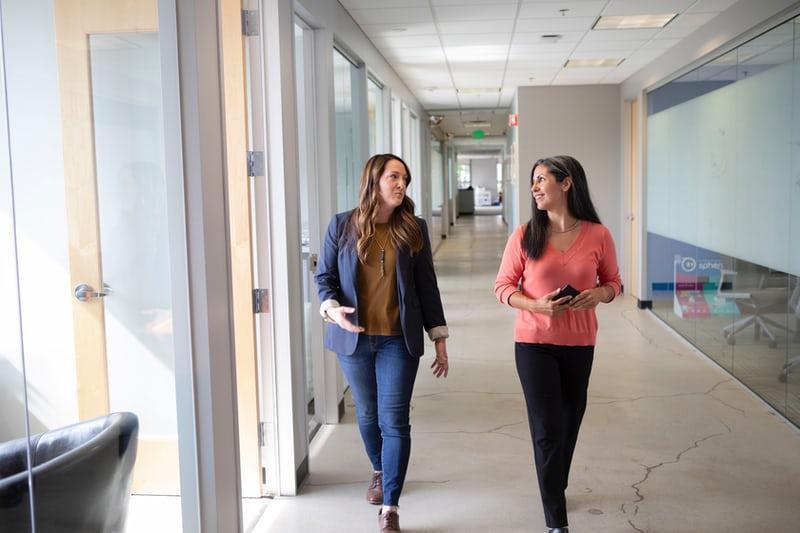
When mobile conversations may support brainstorming and one-on-one check-ins — with practical steps for U.S. office teams.
Conference rooms are designed for presentation, not exploration. Fixed seating arrangements reinforce hierarchy — the person at the head of the table holds visual authority. Screens pull attention away from speakers. Air conditioning and fluorescent lighting create an environment optimized for endurance, not inspiration.
Walking side by side can flatten perceived hierarchy. Without a desk between participants, some teams report more open dialogue. In a Stanford University experiment, Oppezzo and Schwartz (2014) found walking was associated with higher creative ideation scores than sitting in a controlled setting; follow-up effects varied by task. Results from lab studies may not transfer to every office environment.
For operational check-ins, project debriefs, and brainstorming sessions, walking meetings are one optional format that also reduces continuous sitting time. Suitability depends on topic sensitivity, group size, and accessibility needs.

Open-ended creative challenges benefit from the associative thinking that rhythmic movement supports. Bring a small notebook or use a voice memo app to capture ideas without stopping the flow. Set a loose time boundary — 20 to 30 minutes is often sufficient for generating a strong idea list.
Manager-report walking meetings build rapport and encourage candid feedback. The informal setting signals that the conversation is a dialogue, not an evaluation. Walking reduces the intensity of difficult topics by distributing nervous energy into physical movement.
Routine progress reviews rarely require slides. A walking format keeps updates concise — people naturally avoid rambling when they are moving. Prepare three to five talking points beforehand to maintain structure without over-formalizing the exchange.
Upcoming sessions focused on walking meeting facilitation.
| Date | Event | Location |
|---|---|---|
| July 9, 2026 | Walking Meeting Facilitation Skills — Half-Day Training | Birmingham, AL |
| August 20, 2026 | Remote Walking Meetings: Phone-Based Mobile Check-Ins | Virtual |
| October 3, 2026 | Leadership Walk & Talk: Modeling Movement Culture | Virtual |
Consider replacing one optional seated one-on-one with a short walk and gather informal feedback from participants. Outcomes vary by team and topic.
Ask About Educational Resources